
Trading from the chart
TradingLayer is the broker-agnostic trading-state layer of the chart: it keeps normalized orders, positions, executions, and the quote, and hands user actions out as intents (TradingIntent). The layer sends nothing itself — it has no transport, no account, and no retries; the connection to the broker stays with the host.
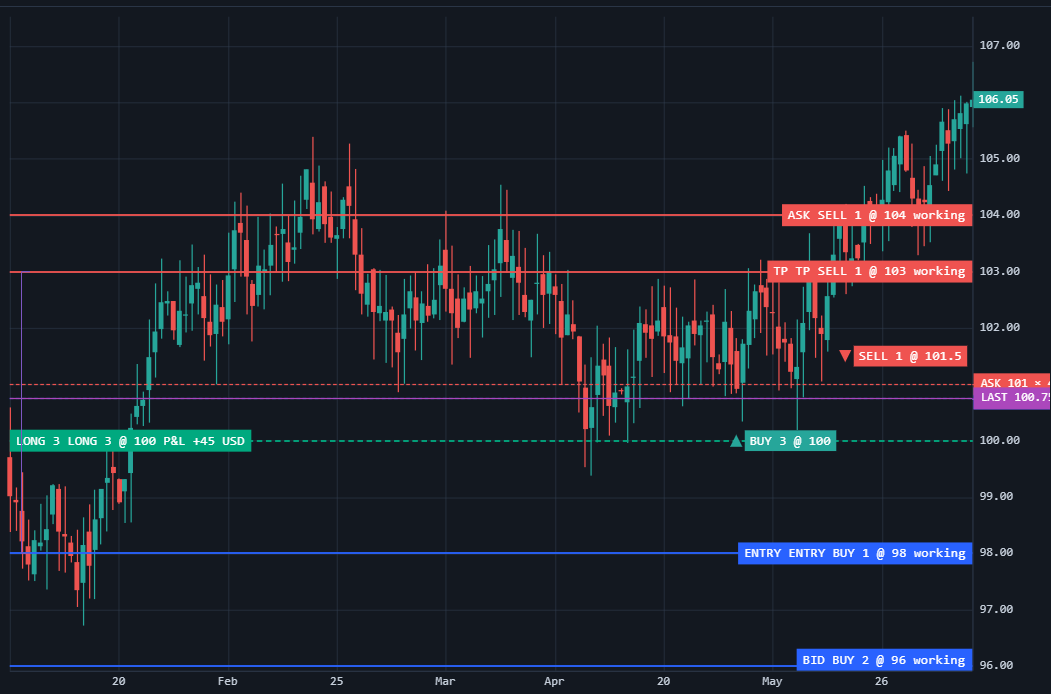
Wiring in
The layer ships as a separate entry point of the @stocksharp/chart package:
import { TradingLayer, TradingLayerPrimitive } from '@stocksharp/chart/trading';
Without a bundler the same classes are available in the global SSChart object (new SSChart.TradingLayer({ tickSize: 0.25 })).
Creating and updating
The layer is created with the price grid parameters, the TradingLayerPrimitive primitive draws its state over the series, and TradingOrderPlacementAdapter turns a click on the chart into an intent to place an order:
import { createChart, CandlestickSeries } from '@stocksharp/chart';
import {
  TradingLayer,
  TradingLayerPrimitive,
  TradingOrderPlacementAdapter,
  type TradingIntent,
} from '@stocksharp/chart/trading';

declare const broker: { send(intent: TradingIntent): Promise<void> };

const chart = createChart(document.querySelector<HTMLElement>('#chart')!, {
  timeScale: { timeVisible: true },
});
const candles = chart.addSeries(CandlestickSeries, { upColor: '#26a69a', downColor: '#ef5350' });

const layer = new TradingLayer({ tickSize: 0.25 });

chart.attachPrimitive(new TradingLayerPrimitive(layer, { showInactiveOrders: false }), {
  series: candles,
});

// The canonical broker state: the chart only displays it and never changes it itself.
layer.setOrders([{
  id: 'ob1',
  side: 'buy',
  type: 'limit',
  status: 'working',
  timeInForce: 'good-till-cancelled',
  quantity: 2,
  filledQuantity: 0,
  price: 96,
  revision: 1,
  permissions: { canModify: true, canCancel: true },
  label: 'BID',
}]);

layer.setPositions([{
  id: 'pos1',
  side: 'long',
  quantity: 3,
  averagePrice: 100,
  revision: 1,
  pnl: { realized: 0, unrealized: 45, currency: 'USD', markPrice: 101.5 },
  permissions: { canClose: true, canReverse: true, canProtect: true },
}]);

layer.setQuote({ time: 1704326400, bidPrice: 100.75, bidSize: 5, askPrice: 101, askSize: 4 });

// Intents go out to the host, and the host answers the layer with the result.
layer.subscribeIntents(intent => {
  broker.send(intent).then(
    () => layer.resolveIntent({ intentId: intent.intentId, status: 'accepted' }),
    (error: Error) => layer.resolveIntent({
      intentId: intent.intentId,
      status: 'rejected',
      reason: error.message,
    }),
  );
});

// Ctrl + left button is a limit buy, Ctrl + right button is a limit sell.
new TradingOrderPlacementAdapter(chart, layer, { quantity: 1, orderType: 'limit', modifier: 'ctrl' });
setOrders, setPositions, setExecutions, and setQuote replace the corresponding collection as a whole. Every call is normalized and compared against the current state: when nothing has changed, the subscribers are not called, and otherwise a change is published with the added, updated (previous / current pairs), removed, and orderChanged fields. The quote is the exception: its change carries only previous and current. The current snapshot is given out by state() — that is { version, orders, positions, executions, quote }.
Normalization is strict: prices must fall on the tickSize grid (with the priceOrigin offset), and quantities on quantityStep when it is set; a limit order requires price, a stop order stopPrice, and a stop-limit order both fields. Inconsistent data is rejected with an exception rather than quietly corrected.
Intents
The layer does not carry out user actions but publishes them as an intent: a request* method returns an intent object, puts it into the pending queue, and hands it to the subscribeIntents subscribers. The host carries the intent out at the broker and closes it with a resolveIntent({ intentId, status, reason }) call with the accepted or rejected status — the outcome arrives at subscribeIntentOutcomes together with the original intent. Pending intents are listed by pendingIntents().
Permissions are checked before publication: modifying an order requires permissions.canModify, cancelling it canCancel, and position actions canClose, canReverse, and canProtect. An order without permissions counts as read-only, and the call throws. The expectedRevision of the canonical entity is put into the intent so that the broker can reject a request built on stale data.
Drawing and dragging
TradingLayerPrimitive is a chart primitive that subscribes to the layer when attached and draws the order lines with their labels, the position line with its P&L, execution markers, the bid/ask/last lines, and the bracket links. What to show and in which colors is set by the constructor options and applyOptions: showOrders, showInactiveOrders, showPositions, showExecutions, showExecutionLabels, showQuote, showPnl, showBrackets, autoscale, the set of colors (orderBuyColor, orderSellColor, inactiveOrderColor, longPositionColor, shortPositionColor, executionBuyColor, executionSellColor, bidColor, askColor, lastColor, bracketColor), lineWidth, fontSize, orderLabelSpacing, zOrder, and the priceFormatter, quantityFormatter, and pnlFormatter formatters. The id is set once at creation and does not change afterwards.
An order line can be dragged with the mouse when the order is active (pending, working, or partially-filled), is not a market order, and carries the canModify permission. While the drag is in progress the primitive shows a preview price snapped to the grid; on button release a requestModifyOrder intent is published, and the preview holds until the host closes the intent — a rejected one returns the line to the canonical price.
Cursor hits are described by TradingOrderHitData, TradingPositionHitData, TradingExecutionHitData, and TradingQuoteHitData; isTradingPrimitiveHitData(value) helps recognize them in a handler.
Placing orders with the mouse
TradingOrderPlacementAdapter connects the chart's own placement signal to the layer: it turns the placement mode on, listens to the clicks, and calls requestPlaceOrder. It creates no price lines itself and does not talk to the broker.
The options: quantity (mandatory), orderType — 'limit' or 'stop' ('limit' by default), timeInForce ('good-till-cancelled' by default), modifier — 'ctrl', 'shift', or 'alt' ('ctrl' by default), color, title, enabled, and sideResolver. The default resolver gives a buy on the left button and a sell on the right one, and null cancels the placement. The adapter is driven by the options(), applyOptions(patch), setEnabled(enabled), and dispose() methods.
Public methods of the layer
setOrders(orders),setPositions(positions),setExecutions(executions),setQuote(quote)— replace the canonical state;setQuote(null)removes the quote.state()— the current state snapshot with the version number.normalizationOptions()— the price grid parameters the layer was created with.subscribeChanges(handler),subscribeIntents(handler),subscribeIntentOutcomes(handler)— subscriptions; each returns an unsubscribe function.pendingIntents(),resolveIntent(resolution)— the pending intent queue and its closing.requestPlaceOrder(order),requestModifyOrder(orderId, changes),requestCancelOrder(orderId)— working with orders.requestClosePosition(positionId, quantity),requestReversePosition(positionId, quantity)— working with the position; without a quantity the whole position is taken.requestCreateStopLoss,requestEditStopLoss,requestRemoveStopLoss,requestCreateTakeProfit,requestEditTakeProfit,requestRemoveTakeProfit— the protective orders of a bracket.dispose()— release resources.
Other exports
- The model enumerations:
TradingSide,ChartOrderType,ChartOrderStatus,ChartOrderTimeInForce,ChartPositionSide,ChartBracketRole,ChartExecutionLiquidity,TradingIntentKind. - The layer and primitive enumerations:
TradingLayerChangeKind,TradingIntentOutcomeStatus,TradingPrimitiveEntityKind,TradingQuoteKind. - Data validation and normalization:
normalizeChartOrder,normalizeChartOrders,normalizeChartPosition,normalizeChartPositions,normalizeChartExecution,normalizeChartExecutions,normalizeChartQuote,normalizeChartOrderRequest,normalizeTradingIntent,normalizeTradingModelOptions. - Helper computations:
quantizeTradingPrice— snapping an arbitrary price to the grid,chartOrderRemainingQuantity— the unfilled remainder of an order,chartPnlTotal— the sum of realized and unrealized P&L. - The
ChartOrder,ChartPosition,ChartExecution,ChartQuote,ChartOrderRequest,ChartOrderModification,TradingIntenttypes and the intent interfaces derived from them.