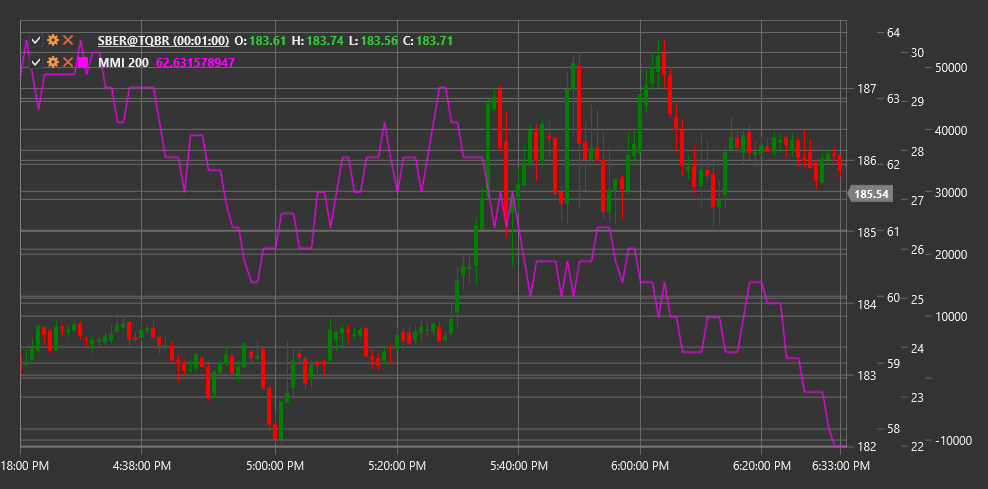
MMI
Market Meanness Index (MMI) is a technical indicator developed to determine whether the market is in a trending or sideways (chaotic) state.
To use the indicator, you need to use the MarketMeannessIndex class.
Description
The Market Meanness Index (MMI) is a tool that helps traders determine the nature of the current market - whether it is trending or sideways. The name "Meanness" reflects the idea that the market sometimes behaves "meanly" or unpredictably towards traders, especially when in a sideways movement.
MMI is based on counting the number of price value pairs (usually closing prices) that do not follow a simple linear pattern, and their ratio to the total number of analyzed pairs. The indicator measures the "chaos" or "randomness" of price movement over a specific period.
The index oscillates from 0 to 100:
- Low values (usually below 50) indicate predominance of trending movement
- High values (usually above 50) indicate predominance of sideways or chaotic movement
Parameters
The indicator has the following parameters:
- Length - calculation period (default value: 20)
Calculation
Market Meanness Index calculation involves the following steps:
Create a set of consecutive closing price (Close) pairs within the given Length period.
Count the number of "non-sequential" pairs. A pair is considered non-sequential if it does not follow the linear pattern typical of a trend. If two consecutive pairs (P1, P2) and (P2, P3) have opposite directions (different difference signs), the pair is considered non-sequential.
Calculate MMI as a percentage ratio:
MMI = (Number of non-sequential pairs / Total number of pairs) * 100
Formally, this can be represented as:
For each trio of consecutive prices (Close[i-2], Close[i-1], Close[i]), check:
- If (Close[i-1] - Close[i-2]) * (Close[i] - Close[i-1]) < 0, the pair is considered non-sequential
- Count the total number of such pairs
MMI = (Number of non-sequential pairs / (Length - 2)) * 100
Interpretation
The Market Meanness Index can be interpreted as follows:
Indicator Levels:
- MMI > 50: Market is in a sideways or chaotic state
- MMI < 50: Market is in a trending state
- The closer MMI is to 100, the more chaotic the market
- The closer MMI is to 0, the more pronounced the trend
Trading Strategy Application:
- When MMI is high (>50), use strategies oriented towards sideways market (e.g., range trading, oscillators)
- When MMI is low (<50), use trend strategies (e.g., trend following)
Dynamics of Changes:
- Decrease in MMI from high levels may signal the formation of a new trend
- Increase in MMI from low levels may indicate trend completion and transition to consolidation
Extreme Values:
- Very low values (MMI < 20) may indicate a strong trend, but also potential overbought/oversold conditions
- Very high values (MMI > 80) indicate an extremely chaotic market where it's difficult to apply any strategies
Signal Filtering:
- MMI is often used as a filter for other indicators:
- Trend indicator signals (MA, MACD) are more reliable at low MMI
- Oscillator signals (RSI, Stochastic) are more reliable at high MMI
- MMI is often used as a filter for other indicators:
Combining with Other Indicators:
- MMI works well in combination with ADX (Average Directional Index)
- Low MMI and high ADX confirm a strong trend
- High MMI and low ADX confirm a sideways market
Timeframes:
- MMI can be used on different timeframes to determine market character
- Long-term MMI helps determine the market's primary state
- Short-term MMI helps choose an appropriate strategy for current conditions